Vertical Cinema: When Commercial Production Borrowed Hollywood's Playbook and Changed American Advertising Forever
Vertical Cinema: When Commercial Production Borrowed Hollywood's Playbook and Changed American Advertising Forever
The advertisement, as a cultural form, has always borrowed from whatever visual medium commanded the most cultural authority. In the broadcast era, the thirty-second spot mimicked the grammar of television drama. In the early digital period, web video aped the conventions of cable programming. What is happening now, however, feels categorically different — less an imitation than a genuine hybridization, one in which the techniques and production philosophies of American cinema are being systematically reverse-engineered for an environment that operates on entirely different terms.
The result is something the industry has not quite settled on a name for. Some call it social cinema. Others describe it as performance content or narrative commerce. Whatever the terminology, the underlying phenomenon is consistent: a growing cohort of US-based creative directors, digital producers, and boutique production studios are constructing brand content with the same intentionality — the same attention to light, motion, composition, and emotional pacing — that has historically been reserved for the feature film and the prestige commercial.
The Frame as a Design Problem
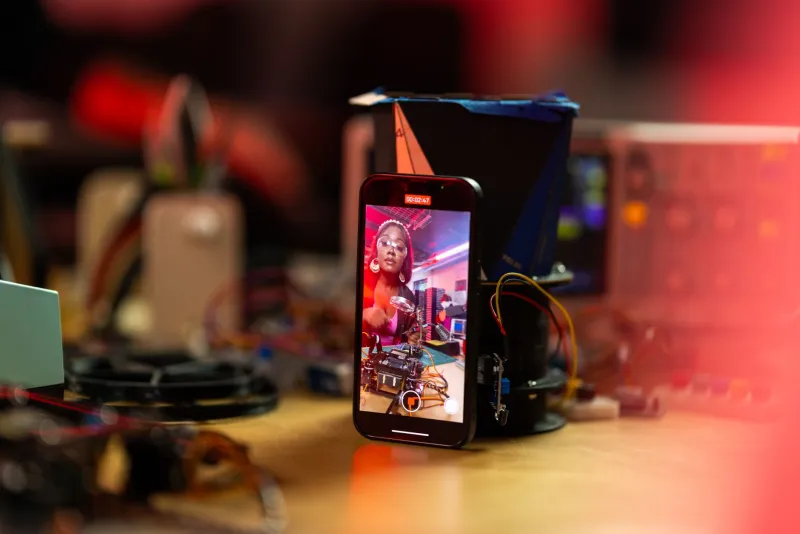
The most immediate technical reality shaping this shift is the vertical screen. The smartphone, held in portrait orientation, presents a 9:16 aspect ratio that bears no relationship to the widescreen formats that dominated a century of cinematic and broadcast tradition. For a generation of creatives trained on horizontal composition, this was initially experienced as a constraint. The more interesting development is what happened when a younger generation of directors — many of whom grew up consuming content natively on mobile devices — began treating the vertical frame not as a limitation, but as a distinct compositional language with its own logic.
Vertical composition concentrates the viewer's attention in a fundamentally different way than its horizontal counterpart. The eye has less horizontal real estate to wander; the subject is almost always centered, close, and immediate. This intimacy, which can feel claustrophobic in the wrong hands, becomes a powerful tool for emotional directness when managed with genuine craft. A close-up that might feel excessive on a theatrical screen reads as natural on a phone. Negative space above and below a subject takes on compositional weight that horizontal framing never afforded.
Several American production companies — particularly those operating at the intersection of branded content and narrative entertainment — have begun developing pre-production pipelines specifically designed around vertical composition, treating shot design, blocking, and lighting for 9:16 as a primary discipline rather than an afterthought.
Cinematic Technique in a Three-Second Window
The second, and arguably more demanding, challenge is temporal. Platform analytics have pushed the advertising industry toward a near-consensus that meaningful audience engagement must be established within the first two to three seconds of a piece of content — before the thumb has time to scroll. This is a creative problem of remarkable severity. The establishing shot, one of cinema's most fundamental narrative tools, is effectively unavailable. The slow build, the deliberate tonal establishment, the patient accumulation of visual detail — all of these require time that the social-first context does not permit.
What has emerged in response is a kind of compressed cinematic grammar, one in which Hollywood-derived techniques are deployed at a radically accelerated pace. Dynamic lighting changes that might unfold over thirty seconds in a feature film are compressed into a single cut. Motion graphic overlays — borrowed from the visual language of broadcast design and VFX-heavy commercial production — are used to carry narrative information in parallel with the live-action image rather than sequentially. Sound design, which in theatrical production operates as a slow atmospheric accumulation, must in this context deliver its emotional signal within the first beat.
The creative directors navigating this environment most successfully are, almost without exception, those with fluency in both registers — individuals who understand why a Vilmos Zsigmond lighting setup works emotionally, and who can translate that understanding into a decision made at a frame rate relevant to an Instagram Reel.
The Boutique Studio as Creative Engine
The institutional home of this hybrid practice is not, by and large, the traditional advertising agency or the major Hollywood production company. It is the boutique digital production studio — a category of American creative enterprise that has expanded significantly over the past decade and that now operates as the primary laboratory for this emerging visual language.
These studios — many of them founded by directors, VFX artists, and motion designers who came up through film and television production — occupy a distinctive position in the creative economy. They possess the technical infrastructure and craft literacy of a production company, combined with the strategic agility and platform fluency of a digital agency. Their client rosters often blend entertainment properties with consumer brands, and the cross-pollination between those two worlds is, arguably, the engine driving the aesthetic development described here.
The tools these studios deploy are themselves a reflection of the hybridization at work. Real-time rendering engines developed for game production are now standard in commercial pre-visualization and on-set virtual production. Color grading workflows borrowed from feature film post-production are applied to sixty-second brand spots. Spatial audio techniques developed for theatrical exhibition are being adapted for immersive brand installations and experiential retail environments.
Is This Still Advertising?
The more provocative question raised by this shift is not technical but categorical. If a piece of brand content deploys the full creative apparatus of cinematic production — a developed visual concept, a crafted emotional arc, a sound design that operates on the audience below the level of conscious awareness — and if that content is experienced primarily as entertainment, with the brand's commercial intent registered only at a secondary level, then what, precisely, is it?
The honest answer is that the distinction may no longer be particularly useful. American audiences have demonstrated, repeatedly and measurably, that they will engage willingly with brand content that delivers genuine creative value — and that they will dismiss, with equal speed, content that treats the commercial transaction as its primary message. The studios and creative directors who have internalized this shift are not producing advertising that disguises itself as entertainment. They are producing entertainment that happens to serve a commercial purpose, and doing so with a level of craft that the traditional advertising industry, operating on different economic and creative assumptions, was never structured to deliver.
The Aesthetic That Emerged
What has resulted from all of this is a distinctly American visual sensibility — one that is simultaneously more cinematic and more immediate than anything the advertising industry previously produced. It is a sensibility shaped by the specific conditions of its context: the vertical frame, the compressed timeline, the platform algorithms, the audience that has been trained by years of prestige television and blockbuster cinema to expect a certain level of visual intelligence.
For studios operating across the full spectrum of visual production — from feature film VFX to branded content to immersive experiential media — this moment represents both a validation and an opportunity. The craft principles that have always governed the most ambitious visual work are not being abandoned in the transition to social-first content. They are being distilled, accelerated, and applied to a new set of frames. The world is still being built. The scroll has simply changed the scale.