The Craft You Never See: How America's Sound Designers Build the Emotional Architecture of Film
The Craft You Never See: How America's Sound Designers Build the Emotional Architecture of Film
There is a particular kind of mastery that succeeds precisely by going unnoticed. In the visual effects industry, a flawlessly composited shot earns its invisibility as a mark of technical excellence. Sound design operates by an identical paradox — and yet, even within the production community, the sonic layer of a film rarely receives the same reverence afforded to its visual counterpart. At Illusions of Works, we believe that building immersive worlds demands equal attention to every sensory dimension. This piece is an examination of the artists who construct the half of cinematic experience that audiences absorb without ever quite seeing.
The Foley Stage: Where the Physical World Is Rebuilt From Scratch
Long before spatial audio algorithms and immersive mixing formats entered the conversation, the foundational craft of sound design lived on the Foley stage — a deceptively simple room filled with props, surfaces, and recording equipment where trained artists physically recreate the sounds of an on-screen world. The footsteps of a character crossing a marble lobby, the specific weight of a leather jacket as a protagonist shrugs it on, the creak of a wooden floor beneath a tense confrontation — none of these sounds are captured during principal photography. They are manufactured, often in real time, by specialists whose entire professional vocabulary is tactile.
In major American production hubs like Los Angeles and New York, Foley artists spend careers developing an almost encyclopedic knowledge of material acoustics. A punching sound in an action sequence might be constructed from the impact of a leather glove against a side of beef, layered with the rustle of a jacket. The roar of a fictional creature in a fantasy film may begin its life as a slowed-down recording of a domestic cat, pitch-shifted and harmonically blended with something far less identifiable. The raw material is always the physical world; the result is something that feels more real than reality.
This labor-intensive process is the bedrock upon which all subsequent sound work is constructed. Without it, even the most sophisticated mixing environment has nothing authentic to anchor the audience's perception.
Sound Supervision: The Director's Sonic Collaborator
Above the Foley stage sits the sound supervisor — or supervising sound editor — whose role functions as something close to a visual effects supervisor, but for the auditory dimension. These are the individuals responsible for the holistic sonic identity of a production: the tonal palette, the spatial logic, the emotional register that sound must carry from the first frame to the last.
Consider the work that goes into establishing the difference between two fictional environments. A spacecraft interior in a science fiction film requires the designer to make decisions about air circulation, mechanical hum, the acoustic behavior of metal corridors, and the way sound propagates — or fails to propagate — in a pressurized artificial atmosphere. None of those reference points exist in the real world. The designer must construct a sonic reality from zero, one that audiences will accept as genuine within minutes of the film's opening.
This is world-building in the most literal sense, and it is a process indistinguishable in its creative demands from the visual development work that concept artists and VFX supervisors perform on the same productions.
Dolby Atmos and the Spatial Audio Revolution
The introduction of object-based audio formats — most prominently Dolby Atmos, which has become standard in major American theatrical releases and a growing number of streaming deliverables — has fundamentally expanded what sound designers can accomplish within a finished mix. Where traditional surround formats assign audio to fixed channel positions, Atmos allows individual sound elements to be placed and moved as discrete objects within a three-dimensional acoustic space, including the vertical dimension above the audience.
For sound designers, this is not merely a technical upgrade. It represents a genuine expansion of the creative canvas. A rainfall sequence can now be engineered so that individual droplets register at different heights and positions throughout the theater. A crowd scene can be constructed so that specific voices drift through the space with genuine spatial logic. Sequences designed to induce unease — a horror film's approach to an unseen threat, for instance — can use the ceiling channels to create a sense of presence that operates below conscious awareness, triggering a physical response before the audience has processed what they are hearing.
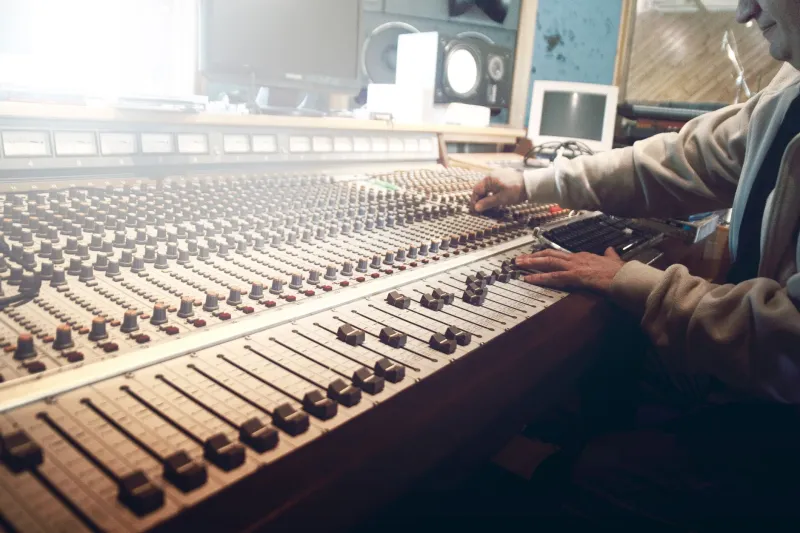
Several leading American sound studios have invested heavily in Atmos-capable mixing stages precisely because their commercial and entertainment clients are increasingly demanding this level of spatial sophistication, not just for theatrical releases, but for theme park installations, brand activations, and immersive exhibition environments.
The Awards Gap and What It Reveals
Despite the discipline's centrality to the cinematic experience, sound design occupies a curious position in the American awards landscape. The Academy of Motion Picture Arts and Sciences consolidated its two sound categories — Sound Editing and Sound Mixing — into a single award in 2021, a decision that drew significant criticism from industry professionals who argued it further diminished recognition for a field that already struggled for visibility.
The frustration is understandable. A visual effects team that constructs a photorealistic digital environment can point to a specific frame and say: we built that. A sound designer who constructs the sonic identity of the same environment has no equivalent artifact to display. The work exists only in the experiential moment — which is, of course, precisely what makes it so powerful, and so difficult to advocate for in a culture that privileges the visible.
Building Worlds That Resonate
At its core, sound design is an act of world-building that operates through feeling rather than sight. The best work in the discipline does not announce itself; it simply makes the constructed world feel inhabited, coherent, and emotionally true. It is the layer of craft that transforms a technically accomplished visual production into an experience — the difference between watching a world and believing you are inside one.
For studios engaged in the full spectrum of immersive media production, from theatrical features to experiential installations, the lesson is consistent: the audience's sense of presence is never secured by image alone. Every frame that Illusions of Works celebrates as a work of visual craft exists within a sonic context that either deepens or undermines its impact. The invisible artists are not peripheral to that work. They are, in every meaningful sense, its foundation.