Painted in Light: The Hidden Science of Color Grading and How It Shapes Every Emotion You Feel at the Movies
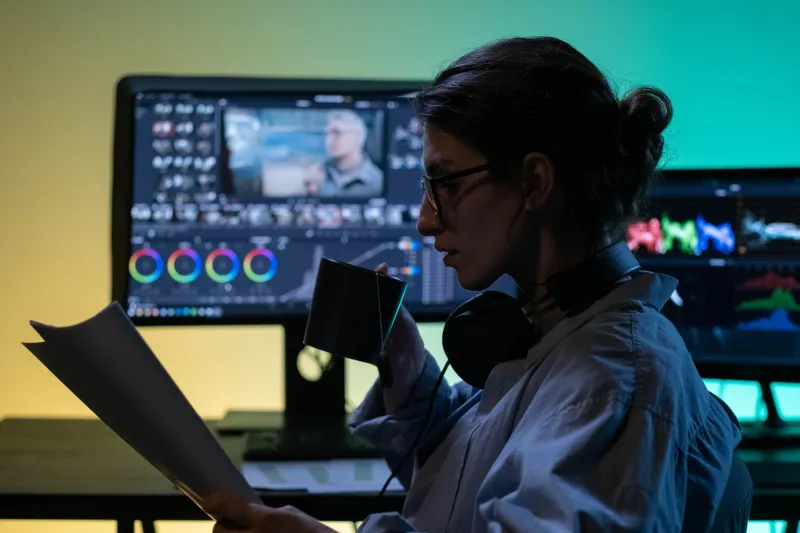
Consider two films released in the same year, shot on comparable camera systems, featuring comparable production values. One bathes its frames in warm amber and deep shadow, conjuring intimacy and moral complexity. The other bleaches its palette toward cool, clinical teal, generating a pervasive unease that lingers long after the credits roll. The difference between these two films — the difference in how they feel, how they are remembered, how they are interpreted — is not solely a function of the script, the direction, or the performances. A significant portion of it lives in decisions made in a darkened room, weeks or months after principal photography wrapped, by a professional most audiences have never heard of.
That professional is a colorist. And their work may be the most influential invisible craft in American cinema.
From Chemical Baths to Digital Suites
The practice of shaping a film's color has existed almost as long as cinema itself. In the photochemical era, the process was called "timing" — a reference to the timed exposure adjustments made in the laboratory during film printing. Skilled photochemical timers could manipulate the density and color balance of a print to a meaningful degree, but their tools were blunt by contemporary standards. The variables were chemical, the feedback loop was slow, and the room for error was significant.
The transition to digital intermediate — or DI — processing, which became standard practice in Hollywood through the early 2000s, changed everything. Films like O Brother, Where Art Thou? (2000) and Pleasantville (1998) offered early demonstrations of what digital color manipulation could achieve at a narrative level, using selective desaturation and palette shifts to reinforce thematic content in ways that photochemical processes could not approximate. The technology opened a door, and the industry walked through it decisively.
Today, the digital intermediate suite is where films are, in a very real sense, finished. Modern colorists work within software environments — most commonly DaVinci Resolve, developed by Blackmagic Design — that offer node-based control over every parameter of an image: luminance, chrominance, hue rotation, saturation curves, contrast ratios, and spatial selections that allow different areas of the same frame to be treated independently. The degree of control available is, by historical standards, almost incomprehensible.
The Psychology of the Palette
What colorists do with that control is rooted in a body of research that spans perceptual psychology, cultural semiotics, and the accumulated intuition of decades of practice. Color, as a communicative tool, operates on audiences at a level that largely bypasses conscious analysis. This is not a metaphor. Neurological research consistently demonstrates that color perception triggers emotional and physiological responses before the cognitive brain has had an opportunity to process what is being seen.
Filmmakers and colorists have long understood this intuitively. The desaturated, gray-green palette of Steven Soderbergh's Traffic — achieved through a combination of photographic choices and post-production manipulation — functions as a visual argument about institutional decay and moral exhaustion. The warm, golden-hour tones of Damien Chazelle's La La Land create a nostalgic ache that makes the film's eventual heartbreak more devastating. The sickly, oversaturated greens of David Fincher's work — particularly in Seven and Fight Club — generate a persistent low-level nausea that keeps audiences off-balance throughout.
None of these effects happen by accident. Each represents a deliberate collaboration between director, director of photography, and colorist — a three-way conversation about what a film should feel like at a neurological level.
The Colorists Shaping American Cinema
Among the practitioners working at the highest level of this craft in the United States, a handful of names recur consistently in the credits of the most visually distinctive films and prestige television series of the past two decades.
Stephen Nakamura, a senior colorist at Company 3 in Los Angeles, has worked on an extraordinary range of projects — from the stark, forensic imagery of Prisoners to the sun-scorched grandeur of Dune: Part One. His work on Denis Villeneuve's films in particular demonstrates the degree to which color grading can function as world-building — the particular quality of light on Arrakis, that amber-bronze haze that makes the planet feel simultaneously ancient and hostile, is as much a product of Nakamura's suite as it is of Greig Fraser's camera work.
Mitch Paulson, whose credits include Moonlight and Beale Street Could Talk, has spoken extensively in industry interviews about the responsibility of color in films centered on Black American experience — specifically the imperative to render dark skin tones with luminosity and complexity rather than the crushed, detail-free shadows that Hollywood's calibration defaults historically produced. This is a technical argument with profound political dimensions, and it reflects the degree to which color grading decisions are never purely aesthetic.
On the television side, the prestige drama landscape has produced some of the most ambitious sustained color work in recent memory. The shifting palettes of HBO's Succession — that particular quality of cold, institutional light that makes every interior feel like a boardroom even when it isn't — are a masterclass in using color temperature as a form of character commentary.
When Color Rewrites the Story
Perhaps the most striking illustration of color grading's narrative power is the case of films where post-production color decisions meaningfully altered the story audiences received. Joel Schumacher's Batman Forever and Batman & Robin are frequently cited as cautionary examples in the opposite direction — their hypersaturated, neon-drenched palettes, while intentional, ultimately undermined the dramatic credibility the stories required.
More constructively, consider the color arc of the Mad Max: Fury Road — a film in which the shift from the bleached, overexposed wasteland sequences to the cooler, more naturalistic tones of the Green Place functions as a form of visual grammar, telling the audience something about hope and its costs before a single line of dialogue articulates it. Colorist Eric Whipp's work on that film is inseparable from its emotional argument.
This is the core proposition of color grading as a discipline: that the emotional meaning of a scene is not fixed at the moment of filming. It is negotiated, refined, and sometimes fundamentally redirected in post-production, through choices about light and hue that audiences absorb without awareness.
Craft Without a Stage
At Illusions of Works, the work we find most compelling is always the work that operates at the boundary between technical mastery and artistic intention — the craft that creates the conditions for feeling without announcing itself. Color grading is perhaps the purest expression of that principle in the contemporary entertainment landscape.
The colorists who shape American cinema work without a red carpet, without an awards category at the major ceremonies, and without the public recognition their contributions arguably warrant. What they have instead is something more durable: every frame of every film they have touched, carrying the invisible signature of their decisions, moving through audiences who will feel the effects of their work for the rest of their lives.
That is a particular kind of power. And it deserves to be understood.