The Ear Believes What the Eye Doubts: Inside the Unlikely Alliance Between VFX Houses and Foley Artists
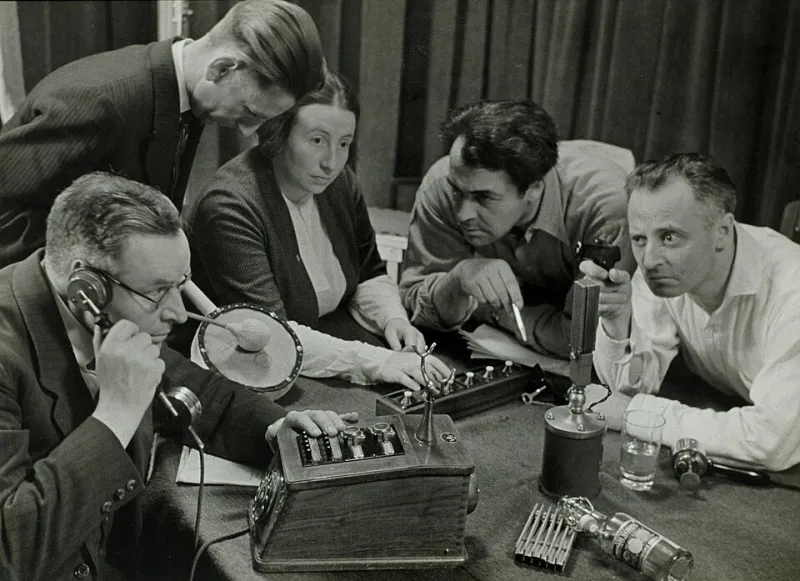
Photo: Wiel van der Randen, Public domain, via Wikimedia Commons
There is a moment familiar to anyone who has sat in a visual effects review room: the shot plays, the room goes quiet, and someone says the words every artist dreads — 'something feels off.' The lighting is right. The simulation is clean. The creature moves convincingly. And yet nobody in the room believes it.
Increasingly, the solution does not come from the VFX vendor at all. It comes from a foley stage in Burbank.
The Partnership Nobody Advertises
Formal collaboration between visual effects studios and sound design teams remains one of the industry's least discussed relationships. Contracts rarely mention it. Credits never reflect it. But ask supervisors at major facilities and a consistent pattern emerges: the shots that audiences accept most completely are frequently the ones where sound designers were brought into the conversation long before the final render was locked.
The reasoning is rooted in perceptual science. Human vision is remarkably forgiving of ambiguity, but the auditory system is a lie detector. Viewers will accept a digitally created river if the water sounds wet. They will reject the same river — same geometry, same lighting, same simulation — if the audio reads as studio-recorded trickle rather than rushing current. The ear sets the terms; the eye complies.
This is why foley artists, the performers who create everyday sounds by manipulating props in synchronization with picture, have become unlikely consultants on productions dominated by digital imagery. Their craft predates computer graphics by decades, yet their instincts about weight, texture, and material truth are precisely what synthetic imagery lacks.
Following One Shot Through the Pipeline
Consider a sequence from a recent tentpole production — a fully digital creature interacting with a live-action actor in a rain-soaked urban environment. By the time the shot reached the sound department, the visual effects team had already delivered what they considered a final render: subsurface scattering on the creature's skin, physically accurate rain occlusion, contact shadows calculated per frame.
The first screening told a different story. Test audiences described the creature as 'weightless' and 'video game-like.' The vendor ran additional simulation passes. Nothing changed.
What changed everything was a foley session. An artist spent two days recording impacts — wet rubber gloves slapped against soaked leather, the compressive squelch of sponge meeting metal — building a library of textures that matched the creature's imagined physiology. When those sounds were synced to the digital performance, the reaction flipped. The same frames that had read as artificial now registered as physically present.
The visual work had not improved. The audience's belief in it had.
Why Audio Buys Belief
Part of the explanation lies in how audiences calibrate reality. Digital imagery is evaluated against a lifetime of visual media — we have all seen photorealistic photography, so our standards are high but our vocabulary is limited. Sound is different. Listeners cannot articulate why a footstep sounds wrong, but they detect falseness instantly and with total confidence.
This asymmetry gives sound designers unusual leverage. A VFX supervisor can defend a render with data — ray traces, reference plates, simulation caches. A sound designer's argument is simpler: it either sounds like it weighs eight hundred pounds or it doesn't. There is no cache to review.
Progressive facilities have begun structuring workflows around this reality. Some now schedule foley sessions during look development rather than post-production, letting the tactile vocabulary of recorded sound inform how digital surfaces are shaded and how digital bodies move. The results, supervisors report, are shots that feel coherent across every sensory channel.
The Lesson for the Craft
The broader takeaway extends beyond creature features. Any digital environment — a fantasy city, a destroyed landmark, a commercial product hero shot — inherits its credibility partly from the audio world built around it. Studios that treat sound as a finishing step are spending money to make imagery that the mix will either rescue or expose.
The old production model separated picture and sound into sequential silos. The new model, still forming, treats them as a single act of persuasion. Audiences will never know which discipline saved a given shot. The artists, for their part, seem content with the arrangement. Belief, once purchased, belongs to the film — not the department that bought it.