Brick, Mortar, and Pixels: Projection Mapping's Second Act
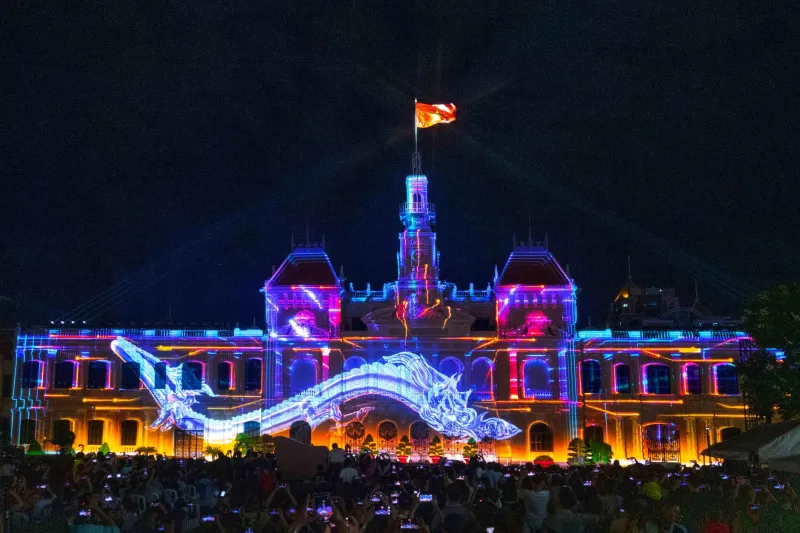
At 8:40 on a Friday evening, a crowd gathers in a downtown plaza to watch a limestone bank building breathe. The cornices swell with color. A line of animation runs along a ledge and vanishes into a window recess, as though the stone had always been capable of movement. Then the sequence cuts, the facade returns to gray, and the crowd lifts its phones — not to record the finale, but to confirm that what they just saw will survive the trip to social media.
That gesture is the whole business model. Projection mapping has spent two decades as a festival curiosity; it is now a commissioned format with clients, contracts, and repeat customers across the United States. What distinguishes the current generation of work is not the brightness of the projectors but the discipline of the people who plan around them.
From Festival Novelty to Standing Contract
The early reputation was civic and seasonal: biennials, holiday light trails, one-night activations attached to a city's tourism calendar. That work still exists, and it remains the sector's most visible showcase. But the growth is elsewhere — product launches that need a photographable moment, sports venues extending the arena experience onto the exterior, museums commissioning facade pieces as part of an exhibition program, and developers using a mapped wall to sell a neighborhood that does not yet exist.
Each of those clients wants something subtly different. A brand wants thirty seconds that reads in a vertical crop. A venue wants something that survives rain and reruns for six weeks. A cultural institution wants attribution, context, and a story that can be defended to a board. The craft is the same; the contract language is not.
The Survey Comes Before the Story
Every successful project begins with a measurement, not an idea. The production team laser-scans the surface or builds a photogrammetric mesh, then spends days with that geometry before an animator draws anything.
The reason is that architecture is not a screen. A facade has depth: columns, sills, recesses, drainage, signage, wiring, and windows that will reflect the projector rather than receive it. Each protrusion casts a shadow at a predictable angle, and each shadow becomes either an obstacle to hide or a design element to use. Experienced teams build the shadow into the animation — letting a cornice throw darkness exactly where the content needs contrast.
This is where the medium reveals its lineage. A mapped building is closer to stagecraft than to cinema. The surface is a scene partner with opinions.
Permits, Weather, and the Neighbors
The unglamorous core of the work is logistical. Historic districts impose review processes and restrict mounting hardware. Municipal ordinances govern brightness and hours. Street closures require coordination with police, transit, and adjacent businesses, some of whom will be inconvenienced on their busiest night of the week.
Then there is the weather. Projectors generate heat and dislike humidity; enclosures must ventilate without admitting rain. Ambient light from street lamps and storefronts must be measured at the actual hour of the show, not assumed from a daytime scouting visit. A run of shows over several weeks requires a technical crew on site nightly, and a contingency plan for the evening a storm arrives forty minutes before the first cue.
None of this appears in the animatic. All of it determines whether the animatic ever reaches an audience.
Calibration Is the Craft
Inside the medium, alignment is the reputation. Multiple projectors are stacked and blended to reach usable brightness on large surfaces, and the seams between them must disappear — not approximately, but entirely. Warping grids are tuned by hand against the real geometry; black levels are matched so that overlapping beams do not produce a visible rectangle of gray; color is profiled to the surface, because aged stone, glass, and painted steel all shift hue in different directions.
Media servers run in sync, cued to timecode, with redundant playback and a manual override that a nervous operator hopes never to use. The output is unforgiving: a half-pixel of drift reads as a shimmer, and a shimmer reads as amateurism.
When the Wall Fights Back
Texture is the argument the building wins. Rough masonry scatters light unevenly; polished surfaces throw it back at the audience. Windows behave as mirrors, so content crossing them appears to double. Trees move in front of the surface and cast live shadows that no previs anticipated. Condensation forms. Someone parks a truck in the sightline.
The best content is designed around these facts rather than against them. Sequences that treat window grids as structural rhythm, that pause on a recess instead of fighting it, that let a real shadow participate in the composition, tend to age far better than the technically impressive ones that assume a perfect wall.
What the Audience Actually Buys
Clients often describe the deliverable as a show. In practice, they are purchasing a photographable moment — a location-specific image that could not have been captured anywhere else, and that carries the venue's architecture as proof of authenticity. That is the competitive advantage projection mapping retains as immersive LED volumes and augmented reality mature: it is public, it is free to attend, and it makes a specific place look like the center of the world for a few minutes.
The second act of this medium, then, is less about spectacle than about stewardship. The buildings are not going to change. The craft is learning how to ask them, politely and precisely, to perform.