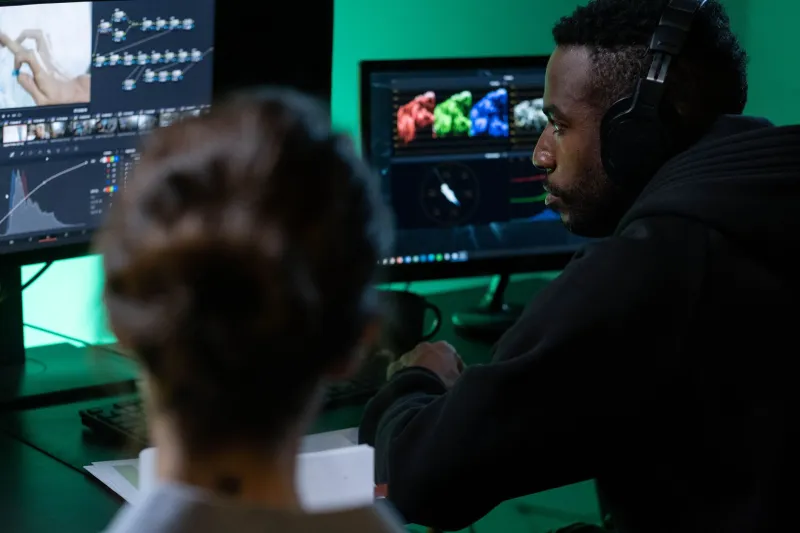
The Invisible Engine: How Render Farm Architecture Quietly Decides What Hollywood Can Dream

The conversation rarely makes it into any production documentary. There is no dramatic music, no sweeping aerial shot of a director standing on a cliff. Instead, there is a conference room, a whiteboard covered in throughput calculations, and two professionals — a VFX supervisor and an IT infrastructure architect — negotiating the boundaries of what a film is allowed to become.
These conversations happen constantly across the American entertainment industry. And yet, the render farm remains one of the least discussed creative instruments in cinema.
The Machine Behind the Magic
A render farm, at its most basic, is a networked cluster of computers dedicated to processing the computationally intensive task of generating finished visual effects frames. In practice, it is far more complex than that description suggests. Modern render farms deployed by major VFX facilities — whether operated in-house or accessed through cloud-based services — can encompass tens of thousands of CPU and GPU cores working in parallel, processing data that, for a single effects-heavy feature film, may total dozens of petabytes.
The scale is extraordinary. What is more extraordinary is how directly that scale governs creative possibility.
"There's a version of every project that lives in the supervisor's head that never makes it to screen," says one senior VFX producer with credits on several top-grossing studio releases. "Sometimes that's a budget conversation. But more often than you'd think, it's a render conversation. It's someone doing the math and realizing that the simulation the director wants would take fourteen months to render on the current farm capacity, and the film ships in nine."
That arithmetic — invisible to audiences, largely invisible to critics — is one of the defining forces shaping contemporary visual storytelling.
Software Optimization as Creative Policy
Render farm capacity is not purely a hardware problem. The software layer — the rendering engines, pipeline management tools, and optimization protocols that govern how work is distributed across available cores — is equally determinative.
Render engines such as Arnold, RenderMan, V-Ray, and Redshift each carry distinct computational profiles. A production's choice of renderer, often made months before principal photography begins, sets parameters that will govern every subsequent effects decision. Scenes designed around a volumetric renderer's strengths look and behave differently than those engineered for a path-tracing solution optimized for speed.
This is where the conversation between technical and creative departments becomes genuinely architectural. VFX supervisors who understand the computational cost of individual effects elements — who know, for instance, that ray-traced caustics in an underwater sequence will demand exponentially more processing time than an alternative approach — can design sequences that are both visually ambitious and technically executable. Those who do not are frequently surprised late in production.
"The best supervisors I've worked with think about render budgets the same way a production designer thinks about physical budgets," notes one pipeline technical director at a mid-sized Los Angeles facility. "They're not just imagining the image. They're imagining the cost of the image, frame by frame."
The Cloud Calculus
The rise of cloud rendering has altered this calculus in ways the industry is still absorbing. Services offered by major cloud providers allow studios to access burst capacity — spinning up thousands of additional cores for a compressed period rather than maintaining that infrastructure permanently. For independent VFX houses, this has been genuinely liberating. Work that would once have required either an enormous capital investment in hardware or a lengthy queue on an oversubscribed farm can now be completed on demand.
But cloud rendering introduces its own constraints. Data transfer costs, latency, and security requirements around proprietary assets all impose friction. Studios producing content under strict confidentiality agreements — which is to say, nearly every major studio production — must weigh the render capacity benefits of cloud infrastructure against the exposure risk of transmitting unreleased assets outside a controlled environment.
The result is a hybrid model that most major facilities have adopted: a stable on-premises core augmented by cloud burst capacity, managed through pipeline software that routes jobs based on security classification, deadline pressure, and cost thresholds. The decisions embedded in that routing logic are, in a meaningful sense, creative decisions.
Data Management as Narrative Constraint
Beyond raw processing power, data management infrastructure shapes what productions can accomplish. A single photorealistic digital character can generate asset files measuring hundreds of gigabytes. A complex environment built for a single sequence may produce terabytes of geometry, texture, and simulation data that must be stored, versioned, retrieved, and ultimately archived.
Facilities that have invested in high-speed storage networks and robust asset management systems can iterate rapidly — artists can retrieve previous versions of a shot, test an alternative approach, and return to the preferred direction within a single working session. Facilities operating on constrained storage infrastructure must make harder choices about what to keep, what to compress, and what to discard. Those choices have creative consequences.
"You lose shots that way," says one data wrangler who has worked across both large and boutique facilities. "A director asks to go back to the version from three weeks ago and it's gone. It was purged to make room. That's not a technical problem in isolation. That's a storytelling problem."
The Render Farm as Creative Partner
Framing computational infrastructure as a purely technical concern misses something essential about how modern visual effects are actually made. The render farm does not merely execute creative decisions — it participates in shaping them. The knowledge of what the farm can accomplish in the available time, at the available cost, influences what supervisors propose, what directors request, and what ultimately appears on screen.
At the most sophisticated facilities, this relationship is managed deliberately. Infrastructure roadmaps are developed in conversation with creative leadership, not handed down from IT departments operating in isolation. Planned hardware upgrades are timed to production schedules. Software evaluations are conducted with specific upcoming projects in mind.
The goal, as one infrastructure director at a prominent American VFX studio describes it, is to ensure that the farm's capabilities are always slightly ahead of the creative team's ambitions — that the machine is never the reason a vision goes unrealized.
That ambition, quiet and unglamorous as it is, may be one of the most genuinely creative acts in the industry. The render farm will never receive a screen credit. But in a very real sense, it is always in the room.